What Does Ideal Inclusion Look Like?
The views and perspectives shared in this article are those of the author and do not necessarily reflect the official position of ZimVie.
A Pride Month Perspective from Berta, EMEA team member
When asked to describe ideal inclusion in one word, my answer would be simple: normality.
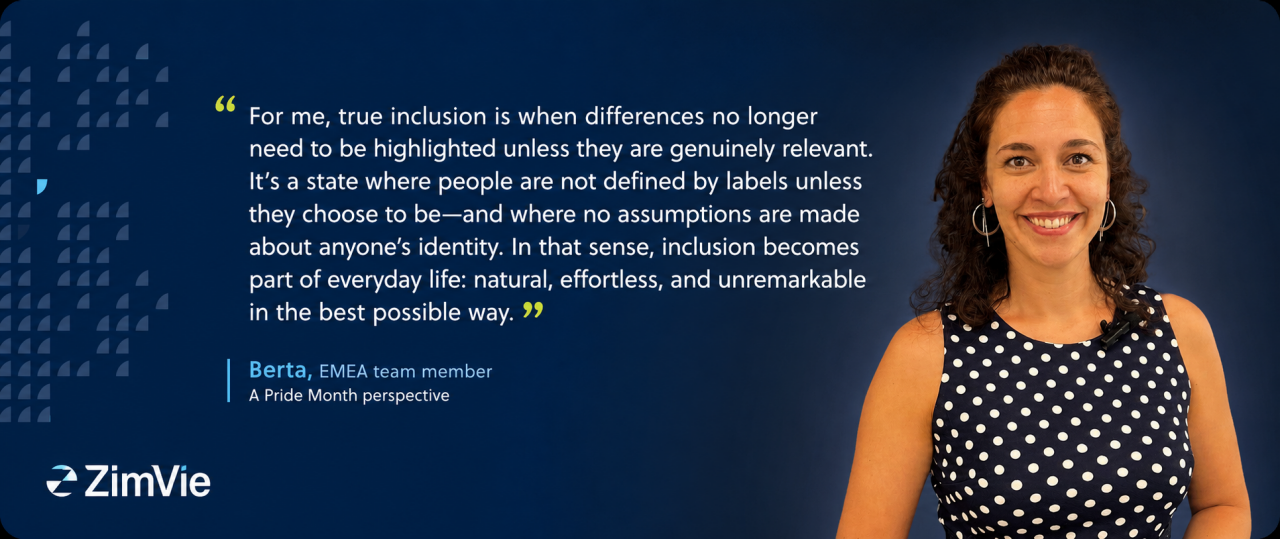
For me, true inclusion is reached when differences no longer need to be highlighted unless they are genuinely relevant. It’s a state where people are not defined by labels unless they choose to be—and where no assumptions are made about anyone’s identity. In that sense, inclusion becomes part of everyday life: natural, effortless, and unremarkable in the best possible way.
Inclusion as a Personal Choice
A key part of inclusion is recognizing that personal aspects of identity—such as sexual orientation or gender identity—belong first and foremost to the individual. Sharing that part of oneself should always be a personal choice, whether with family, friends, or colleagues.
When inclusion is fully embedded in a culture, there is no pressure to disclose, and no expectation to conform to predefined categories. People feel empowered to share what they want, when they want—and equally comfortable choosing not to.
Progress in Motion
At the same time, it’s important to acknowledge that we are not there yet.
We are living through a period of meaningful transition, particularly in how we use language. Efforts to adopt more inclusive vocabulary are essential steps forward, helping to create visibility, awareness, and respect. But language evolves collectively—and real, lasting change takes time. It requires openness, participation, and patience from all of us.
A Global Perspective on Inclusion
Through my work at ZimVie across regions, I’ve seen firsthand how LGBTQ+ inclusion can vary widely around the world.
In some areas, particularly parts of the Middle East and Africa, acceptance is still limited, and conversations around identity must be approached with care. In these contexts, I sometimes find myself adjusting how I express my thoughts, values, and beliefs to align with local realities.
These moments can be challenging, but they also provide perspective. They are a reminder that while Europe still has progress to make, it is also in a relatively advanced position. With that comes both privilege and responsibility.
We have the opportunity not only to continue improving internally, but also to serve as a positive example—demonstrating what a more inclusive and respectful culture can look like.
Beyond Policies—Creating Belonging
Ultimately, inclusion goes beyond policies, terminology, or formal initiatives.
It’s about creating environments where people feel safe, respected, and free to be themselves without hesitation. It’s about fostering a culture where diversity is not just accepted, but genuinely welcomed.
Looking Ahead
Reaching that level of inclusion may still take time—but every step forward matters.
By continuing to listen, learn, and support one another, we move closer to a future where inclusion is no longer something we need to talk about—because it’s simply the way things are.
At ZimVie, I appreciate being part of a company that is committed to this journey—one that encourages open dialogue, respects individual perspectives, and creates space for people to show up as themselves. For me, that’s what makes inclusion not just an aspiration, but something we can actively build together every day.